a brief theory of becoming, pt 3
I. Žižek and the Brain Without Wrinkles
Slavoj Žižek, world travelling televized sniffling philosopher extraordinaire, developed an assemblage of Hegel-Lacan-materialism which is just... flat out ironic ideological capture in the mode he himself attempts calls out. he has recursively enframed himself within their ideological shells and called it a home like a hermit crab looking out into the phenomenal world from the plastic cage. he's casting out books within lenses of antiquated obscurantism through psychoanalysis and dialectics as if he were a literature professor attempting to objectively define the multitudes of Finnegans Wake. by attempting to make meaning from lack, he remains a treadmill exercise in insanity and a sweet red tracksuit.
As brilliant as his critiques can be, the Organs without Bodies is a resentful polemic in which he attempts to undermine in Deleuze a failing he himself is guilty of, and every positive construction is just structural support for the pre-existing form, and in his criticism of Deleuze, each construct falls into the same trap capital recursively lays in absorbing the entropic miasma:
(objectify->enframe)->(trap->sap->husk)
?
because capitalism is just the term for the process of further procuring the peak of a mountain which has been building upon itself recursively for as long as mankind has used language. the mountain is a geist, as mentioned in part one, an enormous mass with a gravity of its own. built on the tools above in varying ideological shapes as subdermal appendages, like the squid in the Dream of the Fisherman's Wife, capital forcibly inserts itself into an enframed assemblage or concept to remove the marrow from its trapped victim to continue to absorb its fluid mass until it is a mere solidified husk.

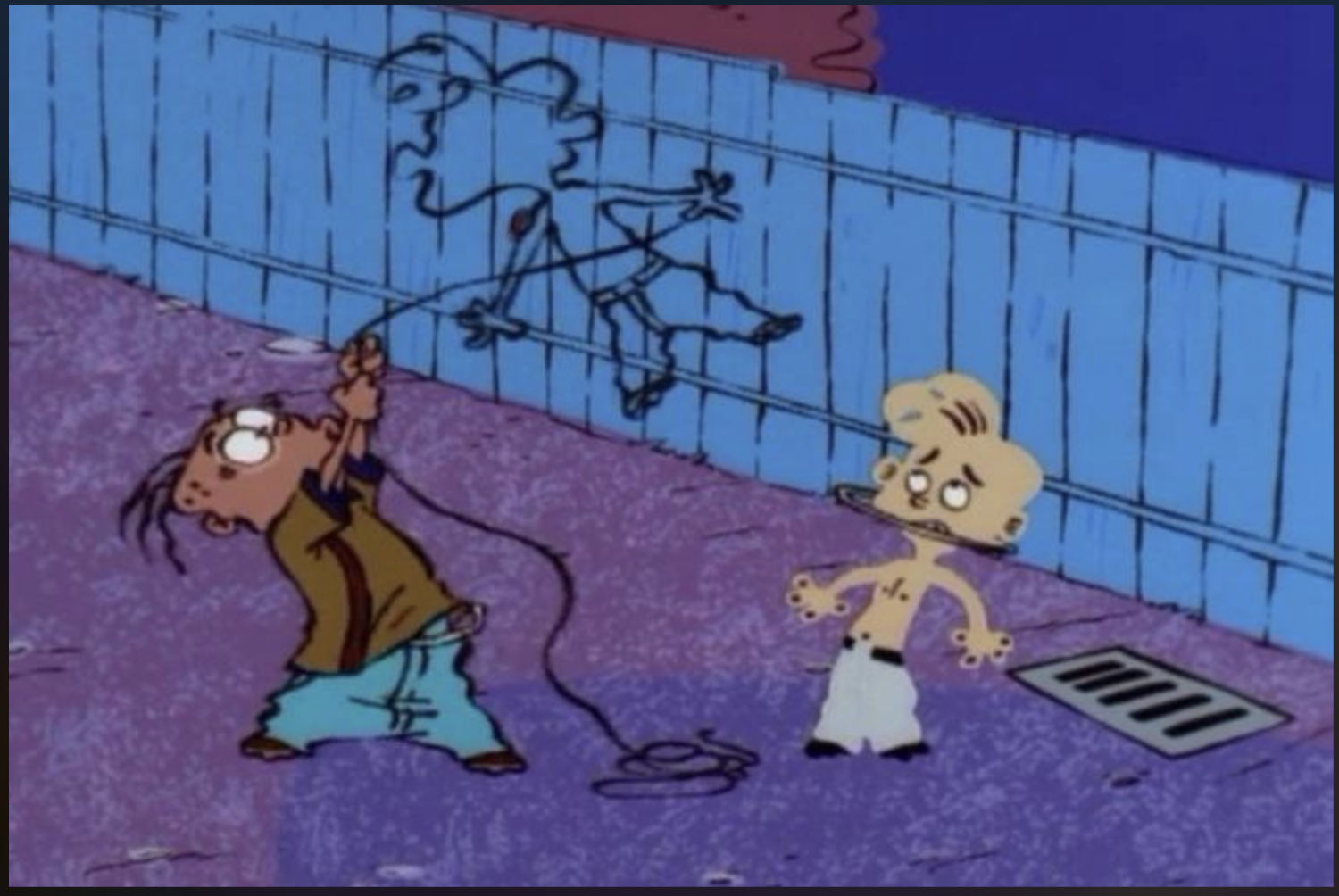
the tools of objectification create an outline in the ether. all potentiality, all possibility, any variation, all becoming, any "thing" at all cannot be without being objectified through deposition. through the shaping tools of language, semiotics, art, technology, we're capturing things to a form, which then narrows their potential. by shaping the shapeless, we have inherently reduced, cupped a vast body of liquid into our hands, giving it the shape our hands enframe it within.

?
the enframing tools are not positive nor negative. they are a necessary form within which we, as individuals, can connect and reach each other. I'm objectifying with language and image in this form from which you are reading, and through such i'm crafting connective mechanism through which we cannot ever truly touch, but the gravity of the mass of the form in which I'm communicating bends your own perceptive experience posthumously. like a hand reaching through a sheet to caress, we never truly touch.
and thus, Žižek attempts to enframe the Body without Organs by imposing a form of lack around the fluid BwO, but lack is inherently porous and empty and can never be filled solid. by calling the BwO a partial object precisely due to its lack, he is calling it partial due to it missing something essential from its enframed trap; rather, the trap is he is giving essentiality to a solid form which never was, and the essence of the partial concept was always fluid, never to be made whole. Žižek's own objet petit a is finding lack where it never existed, filling in one of the last permeations in the membrane where fluid concepts had exegesis.
that's not to say his critique has no use. in form, critique (inherently the tool of identifying lack) has the capability to shine light across voided potentiality, finding the potholes and pitfalls this specific ressentiment-based lack creates.
the potentiality and folding of subjectivity, complexity, and difference Deleuze folds outward to new intensities of conception, like the gyri and sulci of a brain, Žižek attempts to iron out these wrinkles by flattening all potential of becoming, reverting back into nihilistic, resentful lissencephaly, creating a Brain without Wrinkles.
?

?
and so, even in his own chronology Žižek opts to present himself as one whom preferred to comment and observe Hollywood over connecting to the poetry of his own country, preferring to comment on pop culture over the subject he himself felt he was commenting within, calling himself a stain within the ruling orthodoxy (in a surprisingly Lacanian slip).
II. Commonzeal
Mark Fisher relied heavily on Žižek's criticisms throughout "Capitalist Realism", then eventually realized Deleuze provided all the tools necessary to build a project through the positive; an alternative mechanism that counters capitalism's mode of trap->sap->husk by routing around the capture model.
Fisher's attempt focused on "Acid Communism", a brilliant observation from social criticisms which observed the sloughing mechanism psychedelics help produce: the shape of things can be seen from a higher purview, above the objectified form. through psychedelics, you can occasionally see the objectified outlines that have been placed upon you, all things in conception, and dwell within the entropic miasma, watching the attempts of the mind to build and rebuild the rigid outlines that allow connection. shapes form and pass and shift and fold and dissolve and begin and end and shape and pool and cry and empty and fill, recursive waves over waves of experience, never truly taking shape, just existing without form. by breaking down and dissolving these shapes, at least temporarily, we can slough off these appendages of capital capture which have isolated us and drained us of our possibility and desire to be something more than the territorialized shape imprinted upon us by ourselves within the lens of psychoanalytics, by forces of power through the nuclear family, by the overbearing control of society through consensus reality reduced to a solid form by territorializing objectifiers such as politicians, engineers, lawyers, doctors, even artists and especially capitalists and scientists, into a reductionist materialism lifted still by the overbearing corpse of god pulling a recursive puppet string from the geist through the sky through the god back through the individual, forever entangling and intertwining into a confusion under which even Christians divert from God to Trump as their idol.
through communism, Fisher attempts to reinvigorate an alternative to capitalism. communism itself attempted to do this, by creating the term as a corrective measure to distance from socialism within the Communist Manifesto. that attempt in avoiding language capture has been attempted and attempted, each time in futility.
I think giving a word to whatever shape the alternative to capitalism should take at once enframes and provides a target to undermine, trap, sap, and husk.
I drink your milkshake
We saw this take place most prominently in punk. Situationist International broke the trappings and laid bare a model of difference, deviating from capitalism in the shape of acts like derive, or drift, providing activity that directly avoid the possibility of capture by always shifting and changing, following whimsy and random intentionality that did not involve grafting onto a return on investment or providing value. Punk derived its ethos from SI, kept the angst and anger and repulsion from status quo and lost the things that gave it weight, a model like drift from which capture was diverted and avoided and remains uncapitalizable. Punk was trapped by language and politics and aging, then sapped through commodification and isolation and identity politics and now remains a husk of its former ethos.
rather than giving an ideology such as communism a target, let's share a concept which can be consumed, absorbed, modified in the same way, but the ethos remains: commonzeal.
revert back from commune to that which is common; a chain amongst us through language. originally, I wanted to use wealth- "wealth" to its parts: weal, which is well-being, then grafted on over time a connotative -th which is sourced from a state of a thing (where wealth was the state of well-being which became bastardized by capital to mean a state of financial richness). but zeal is the true intention of the concept- an energetic, enthusiastic, determined drive toward an objective. this word will soon be husked as all language has been, but if the conceptual intention is there, the word may shift and become something else, but the conception as I've laid it and the thrownness from which you're observing the word in relation to the zeitgeist, its meaning will transcend.
commonzeal is the praxis of name-state transition from which concepts can chain and connect and infect, through energetic becoming toward the objective of diverting capitalist territorialization, lingual decoding and recoding, and predicting and evading capture.
III. becoming missingno.
Satoshi Tajiri's development of Pokemon Red and Green in 1996 (and Red and Blue in the US in 1998), the handheld games for the original Nintendo Gameboy, was one of the last positive cultural moments in world history.
Tajiri became inspired in a time when his home was changing drastically. born in 1965, he lived and grew in then rural Machida, Tokyo. in his youth, he would run around rural Japan and catch and trade insects with his friends and come up with clever ways to capture more; placing traps and seeking out their hiding spots, unconcealing the insects around rice paddies and rivers and forests, bringing them forth from the world and unveiling them into his and his friends' shared experience.
"It was full of nature. Then development started taking place, and as it grew, all the insects were driven away. I was really interested in collecting insects. [Later, Tajiri's father tells me the other kids used to call Satoshi "Dr. Bug" as a child.] Every year they would cut down trees and the population of insects would decrease. The change was so dramatic. A fishing pond would become an arcade center."
then as a teen, his home industrializing, he, in reflection to his environment, became obsessed with anime and video games, spending his time in arcades and indoors, alone, watching shows. a self described Space Invader junkie, he turned his passion for gaming into a popular magazine called Game Freak, sharing handwritten tips, tricks, and unveiling secrets found within the games. while this inspired now-capitalist was bringing in money as a teen media mogul, he was dissatisfied with his experience. games were flattened and uninspired, and the more he learned, the more they frustrated him because of how desolate they were. in response, he felt the need to recall his experience as a child for inspiration:
"TIME: Did you get the idea for Pokemon from these insects?
Tajiri: Yes. Places to catch insects are rare because of urbanization. Kids play inside their homes now, and a lot had forgotten about catching insects. So had I. When I was making games, something clicked and I decided to make a game with that concept. Everything I did as a kid is kind of rolled into one--that's what Pokemon is. Playing video games, watching TV, Ultraman with his capsule monsters--they all became ingredients for the game."
and so Pokemon was created. the world connected around a new concept which at once digitized, reorganized, refocused and built as a monument the sentimental piece of an experience through the eyes of a child collecting and cataloging insects with wonder and amazement in the world. Tajiri reimagined his beloved childhood of walking through tall grass, abandoning fear and adventuring through the world, experiencing all the difference available to a child, then ritualistically repeating, growing, becoming a Pokemon Master. Game Freak managed to at once provide and capture an essential piece of childhood experience.
but, that also meant GameFreak captured an essential piece of childhood experience. Pokemon mirrored a form the world has trended toward since: reducing things into a catalog, and even as those things changed and evolved, they were catalogued, named, described in total; flattened into a two dimensional shape that could be traded and shared, always to remain in that two dimensional shape, to be flattened, to be owned, and the only form of connection with others was through transactions of the flattened, owned things or by proving your things were objectively greater than your competitors through battle.
TIME: Why did Game Boy seem right for Pokemon?
Tajiri: The communication aspect of Game Boy. It was a profound image to me. It has a communication cable. In Tetris, its first game, the cable transmitted information about moving blocks. That cable really got me interested. I thought of actual living organisms moving back and forth across the cable.
TIME: Wasn't the cable being used for players to compete with each other? In Pokemon, players are sharing, too, aren't they?
Tajiri: Yeah, everyone was using it to compete. The idea I had was for information to go back and forth. It wasn't about competition. Even before Game Boy, there was a communication capability at game arcades--like two race car drivers sitting next to each other to compete. That's all anyone was doing, using it to compete.
TIME: But if you're not competing, games aren't all that much fun, are they?
Tajiri: I liked competition too. But I wanted to design a game that involved interactive communication. Remember, there was no Internet then. The concept of the communication cable is really Japanese: one-on-one. It's like karate--two players compete, they bow to each other. It's the Japanese concept of respect.
TIME: Like the ritualistic elements of sumo?
Tajiri: A more casual form of sumo. Over the Internet, communication can be directed to anyone in the world and it's anonymous. But with a communication cable, it's one-on-one and the players pick who they play against. It doesn't really get aggressive. It's an intricate style of communication. Almost subtle.
Tajiri obviously had a keen eye to things that mattered. intricate communication, yes, but at the time, a physical communication cable was still intimate. the cable quickly went away in later generations in preference to wireless and internet-based transactions. but upon the release of Pokemon Red, Blue, and Green, the communication cable allowed anyone to connect, trade, communicate, and experience, together. This seemed to be a key aspect to the entire moment, and why it brought something truly different and connective. but in this, Tajiri also captured more than his own experience, turned into a digital artform; he captured the experience of an entire generation, and there was no release from this capture. Tajiri continued to iterate on his creation with the releases of Pokemon Yellow, which utilized the newly released anime and attempted to recreate the experience of the main character, Ash Ketchum, which was uniquely popular in the US with over 2 million more sales than Japan. Then Nintendo released the Game Boy Color, and alongside that, Tajiri released Pokemon Silver and Gold. His art was still in flux at that time, as Tajiri recognized something deeply innovative about his experience. by introducing a new land and new Pokemon to experience, he gave fans more and more of what they desired, but the critical piece from his childhood that he captured for himself as the artistic vision of the original game, he further managed innovate his personal experience from creationing the first game directly into the new game - nostalgia. Pokemon Silver and Gold were a complete recreation of both experiences of Tajiri-child and Tajiri-adult in recursive remembrance of his childhood through nostalgia for himself in the original games, and by reintroducing the Kanto world from the original games, his own experience of nostalgia was artistically grafted onto Pokemon Silver and Gold; they were innovative but not as innocently artistic as the original games. capital soon infected, and innovation stalled.
Game Freak has spawned dozens of games, and each generation continues to use the techniques Tajiri crafted with remakes such as FireRed and LeafGreen, SoulSilver and HeartGold, and new generations with new Pokemon. Tajiri stepped away from creative direction after Silver and Gold, and the company is left to mine and extract from its customer base in the form Tajiri designed decades prior. and that experience has flattened as well, all iterations on the two core concepts Tajiri communicated through art: a phenomenological experience of the childhood joy of catching and sharing bugs, and the recursive joy of recalling that experience through nostalgia. Tajiri, in that respect, was an artist, and in a Deleuzean sense, a philosopher:
"But I liked coming up with new ideas. Like how to catch beetles. In Japan, a lot of kids like to go out and catch beetles by putting honey on a piece of tree bark. My idea was to put a stone under a tree, because they slept during the day and like sleeping under stones. So in the morning I'd go pick up the stone and find them. Tiny discoveries like that made me excited."
These tiny discoveries were a communication of concepts in exactly the mode described in What is Philosophy? by Deleuze and Guattari. The tiny discoveries, the small concepts created and communicated and shared and enjoyed infectiously then passed on, that is something new and an experience that is essential.
Tajiri turned his experience into an object, crafted a structural enframing through which that experience became a concept, and then in several highly intricate ways capital trapped it, inserted into it, sapped the essence from that experience over and over again recursively through nostalgia, leaving Pokemon a solidified shell, a husk of the original experience. In many ways, Tajiri's efforts show that a way out of the capitalist model is still possible even though his entire life was commodified by an industrialization of his total experience from a young age. it's telling that at one point he desired to become an entomologist, an ultimate form of reductionist materialism under which the world of insects are themselves catalogued in a fashion similar to a termite, built mounds of partially digested saliva, soil, water, and feces stacked upon itself in a shared effort to build underground tunnels and cement-like towers called science. had he gone into the sciences, his experience would have never been communicated to the world. and the world would have incentivized his pursuit in that direction were he born in a later stage of capital.

The full TIME interview with Tajiri is laced with anxious trepidation and critical insight.
In the development of the original games, an accident occurred. slots were designed to hold each sprite and the Pokemon's characteristics, and within the memory compression of the game some slots were left unused once the Pokemon count was reduced to 151 sprites. the leftover Pokemon slots were unable to be reached in the areas where Pokemon were randomized into, and as such the slots were left unaccessible. yet, one area within the game allowed a player to travel along a periphery, and the random possible interaction of that slot was left in the narrow transitory space between land and water in the game, allowing players to interactive with a non-Pokemon. this non-entity was missingno.
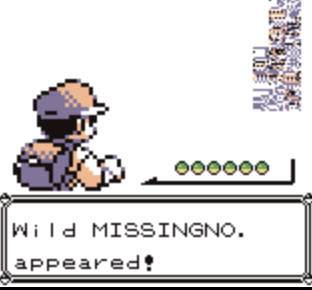
missingno was a slot of code scraps, bits and pieces of unused Pokemon that was never intended to be brought into existence. it presents in a few alternative forms as a ghost, as fossils, or as further damaged sprites, but the backwards L shaped block has become the most prominent in culture. short for Missing Number, it appears as Pokemon 000 within the Pokedex. there is something uniquely prescient about the image that requires further discussion. Wikipedia offers quite the in-depth review of its public reception:
The 2017 book 100 Greatest Video Game Characters describes MissingNo. as an example of a player-produced character and counterplay, adding, "as a cultural artifact, MissingNo.] celebrates the creativity of deviant and subversive forms of play".
Several authors have examined how video game glitches, including MissingNo., impact the player's perception of a game. In the 2004 book Pikachu's Global Adventure: The Rise and Fall of Pokémon, professor of education Julian Sefton-Green noticed that in his study of his son's reaction to MissingNo.'s usage as a cheat, the child's outlook towards the game was altered drastically, and added that the presence of such elements, as a result, broke the illusion of the game as an enclosed world and reminded him that "at heart, it is a computer program".
In his 2008 book Playing with Videogames, James Newman commented that unusually MissingNo. caused players to celebrate the game's imperfections.
In a 2017 article, University of Portsmouth professor Lincoln Geraghty examined fan theories that the glitch was a cut Pokémon related to the Pokémon Kangaskhan and Cubone, describing the theory as "an established work of fanon"; he further elaborated in a 2019 Ars Technica article that "fans' desire to incorporate MissingNo.] into the Pokémon world stems partly from a hope that the glitch may have been deliberate", as well as to compensate for the glitch's lack of backstory within Pokémon canon. In the same article, Newman argued that the existence of such fan theories "reveals a belief in the fundamental reality of Pokémon as entities that are given an opportunity to show themselves through the game, rather than being constructed out of code".
In a 2017 paper, Justyna Janik of Jagiellonian University similarly observed that fans consider MissingNo. to be part of the games' mythology, in a similar way to Super Mario Bros.'
In an essay published in the 2021 book Miscommunications: Errors, Mistakes, Media, Nele Van De Mosselaer and Nathan Wildman argue that video game glitches such as MissingNo. are fundamentally different to errors in other forms of media such as movies and books, due to the interactive nature of video games, which facilitates fans creating lore around them that is not seen with errors in other media.
missingno lives in gray area in more ways than one. in legal purview, there is discussion that because the sprite was generated purely by accidental computer glitches that it is not protected under copyright, trademark, or other legal protections and belongs within the public domain. in game, missingno can be utilized to exploit the game, creating access to Pokemon that could not be reached otherwise, multiplying items ad infinitum, yet it also has the potential to corrupt the game, destroying the hall of fame and pokedex and other sprites and indexes within the game.
this discovery was an unintentional rupture. the incredible weight of the momentous concept which Tajiri developed in Pokemon could not contain all the enclosing pressure in one rigid outline, so that concept generated its own offshoot as the Pokemon games were encapsulated in capitalist fashion. missingno has remained a periphery since its unveiling, and as such, has remained evasive from capital.
the way missingno moves through the game is an intriguing image; if one were to look at language as one mode of objectification, as a tool from which an outline forms around an idea, within which all multiplicative potential is limited and reduced to a singularity, the missingno glitch appears to present the possibility for infectious conveyance of concepts and ideas through the periphery prior to entrapment, as formation of partial concepts just enough to convey an idea while avoiding pillaging by capital.