a brief theory of becoming, pt 1
spiraling
spiraling
spiraling
I. the eternal return
Friedrich Nietzsche commanded a concept into existence he named the eternal return. it's commonly interpreted as a thought experiment, though naming it a thought experiment has an inherent downfall- you cannot understand the true depth of the implicit experience if you simply call it a thought experiment. stated as follows:
What if some day or night a demon were to steal after you into your loneliest loneliness, and say to you, "This life as you now live it and have lived it, you will have to live once more and innumerable times more; and there will be nothing new in it, but every pain and every joy and every thought and sigh and everything unutterably small or great in your life will have to return to you, all in the same succession and sequence" ... Would you not throw yourself down and gnash your teeth and curse the demon who spoke thus? Or have you once experienced a tremendous moment when you would have answered him: "You are a god and never have I heard anything more divine." - Friedrich Nietzsche, The Gay Science, Section 341, The Greatest Weight
Taking this thought to its mathematical use of the term limit exposes two threads. first, the finality of this life is the greatest weight we must carry. if life is only lived once then we must make it worthwhile. second, rather than focusing on the gravity of the lowest lows and making suffering more bearable by easing the pain, we must exemplify the highest highs life has to offer to make it worthwhile.
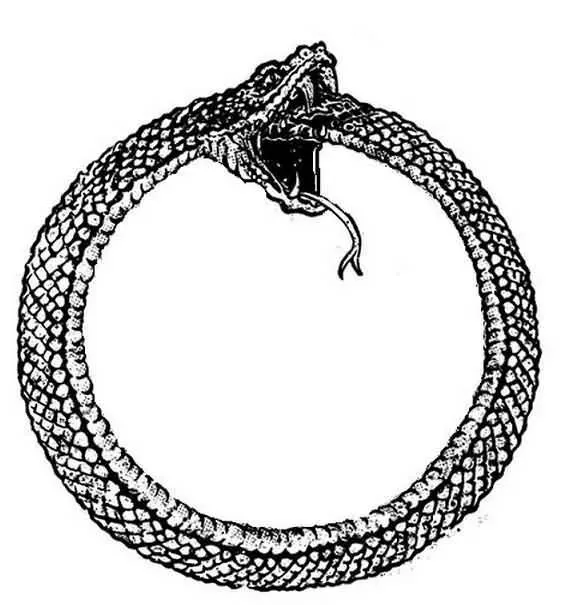
quite succinctly Nietzsche exposes the failures of religions such as christianity and buddhism. there is no afterlife, once this life ends, to justify the sorrow as christianity proclaims, and believing such undervalues the one life we have. life is not defined by its suffering, as buddhism proclaims, but its peak moments.
the most prominent use (or misuse) of this theory was in True Detective season one, where the phrase "time is a flat circle" is used to portray the eternal return as a literal recurrence, where the villain has "seen you before, in my dreams".
https://www.youtube.com/watch?v=JUfN8wL5zKY
from this point we diverge.
a flat circle is does not properly portray the levity, the depths, the variety of experience. alternatively, let's view life as an isometric conical spiral.
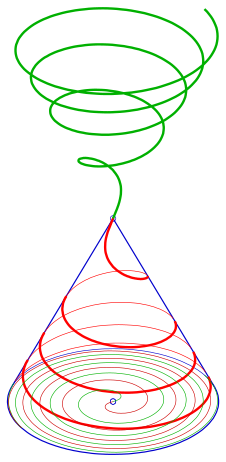
the spiral is still just an image - in this usage, picture a spiral as a life finished. a spiral does not form at birth, but is formed through the process of becoming, and the appearance of the spiral is what remains after we have reached death at central pole. consider this shape as a three dimensional form of Vonnegut's Story Shape model for describing the shapes a story takes across a two dimensional axis of time/experience. let's see if we can convince ourselves how well it fits the experience of life.
II. becoming is fluid
time in the experience of an individual is finite, but constant. in the moment, you can even experience it in a straight line; past -> present -> future. this is specious. it seems it must be true. our entire modern language says to focus on being in the present moment, using images and symbols to understand a thing as an instance, like defining a tree as a tree because it has "treeness". it looks like a tree right now, it will look like a tree for a long while. but what makes a tree a tree other than the word we use to call it such?
being is not a possible state.
now i've lost you. how is "being" not possible? I am, is that not "being" me?
???
imagine time as it is felt. linearity is not the only feeling associated with time. time has a felt "weight". if we take this into account, we can say time-weight, as it is felt, is constantly acting on us in a downward force.
as a child, time is hardly noticed; it feels limitless. seasons feel new each year. you're constantly surprised summer has ended and you're returning to school. vacations come and go, people enter and leave your life and your time with loved ones dwindles.
as life goes on, the feeling of time begins to accelerate. years seem to fly past us, differences and experiences go unnoticed relative to the time spent experiencing them. the weight of this time appears to increase rapidly because you've felt these feelings of change many times over. you haven't repeated past moments exactly, but they do carry a charge of having been felt once before. history doesn't repeat, but it does rhyme. as we age further, nearing death, we begin to feel time is running out. time has not changed. the weight of time felt has become more apparent because an end to the experience is a certainty. but the weight of time has remained constant. but remember Ben Franklin's adage, "in this world only two things are certain, death and taxes". we're less interested in the latter.
following this image, we can see a few of these commonalities in typical life experience overlapping the model: at a certain point, life begins. at a certain point, life ends. inbetween, time-weight is constantly adding pressure to our lives, typically as we near the end. early on, life is new and exciting, full of difference and experience. time is in constant flux (the speed of flow during a certain unit of time) but the weight due to time increases as our spirals shrink. if we think of our experience of life as the flow of a fluid through time, we can see that it never actually stops. if it could stop, the experience of a single slice of time would be an instance of being. since the experience of time cannot stop, the proper word to use is becoming.
here I could quote all sorts of fluid dynamics transport theory equations. we're not quite there yet.
But we didn't answer the reason time exerts more pressure on us as we age if it's a constant! that's really where the image of the spiral comes in - the law of angular momentum.
picture yourself spinning in your computer chair. as you spin, you pull your legs toward your center and your speed increases. you can feel your blood rushing away from you, outward. the closer you pull yourself to center, the faster and faster you go while all of your organs and blood and anything not immediately attached to you wants to fly off. as time-weight exerts its downward force, your spiral pulls you to a central point while the pressure feels more and more immense.
ok, so time-weight is a downward force. what causes your spiral to be so wide when you're young, and so small when you're old? difference.
when you're young, all experience is new. you're thrown into a life that was already in motion around you, you've never felt anything, and now you're feeling all these new experiences; they're all different. breathing, warmth, cold, tummy aches, movement, musculature, agitation, digestion and so on. the widest point the circle of experience can flow is the apogee, then experiences begin to repeat into familiarity. repetition draws the circle back to the center of your experience. new experiences continue to occur and then continue to repeat. you learn to speak, you learn new words, you learn to walk, to read, to run, to love, to live. as time flows on, experiences repeat unending. nothing new seems to occur; things change, yes, but they rhyme with your past experiences rather than truly repeat ad nauseum.
so the experience of difference and repetition form the ring shape of the spiral, and the force of time-weight is constantly bringing your experience of becoming to its focal point. as repetition increases and difference decreases, the spiral shrinks over time. as time-weight force is applied, the spiral moves down. the rate at which life seems to move faster and faster is inversely correlated to new and different experiences.
so the experience of life-pressure increases the longer you live and the more life repeats. how does this "pressure" work on us?
the spiral is an after-image of a life lived after it reaches a point of death.
so much time, so little to do.
?
strike that, reverse it.
III. having-been and the solidification of experience
this spiral image was at one point an experiment of turning Vonnegut's thesis of "story shapes" into three dimensions. as such, the entire thesis is operating on describing an event that has already happened. a spiral is only formed after life is experienced- a skeleton; a life lived in time. it's proof that someone has-been, and that cannot be excised from time. but the spiral is being formed in real-time, and we can feel that as well: we think about the past and the feelings had at the time, observe your interpretations and quality and quantification of experience, know things have happened in reference to other events; but we can't change the events or the experience as-lived. that feeling is of having-been. as a living person, you have experienced difference, repetition, time, and so on.
if becoming is fluid flow, having-been is the fluid solidifying.
let us again describe the experience.
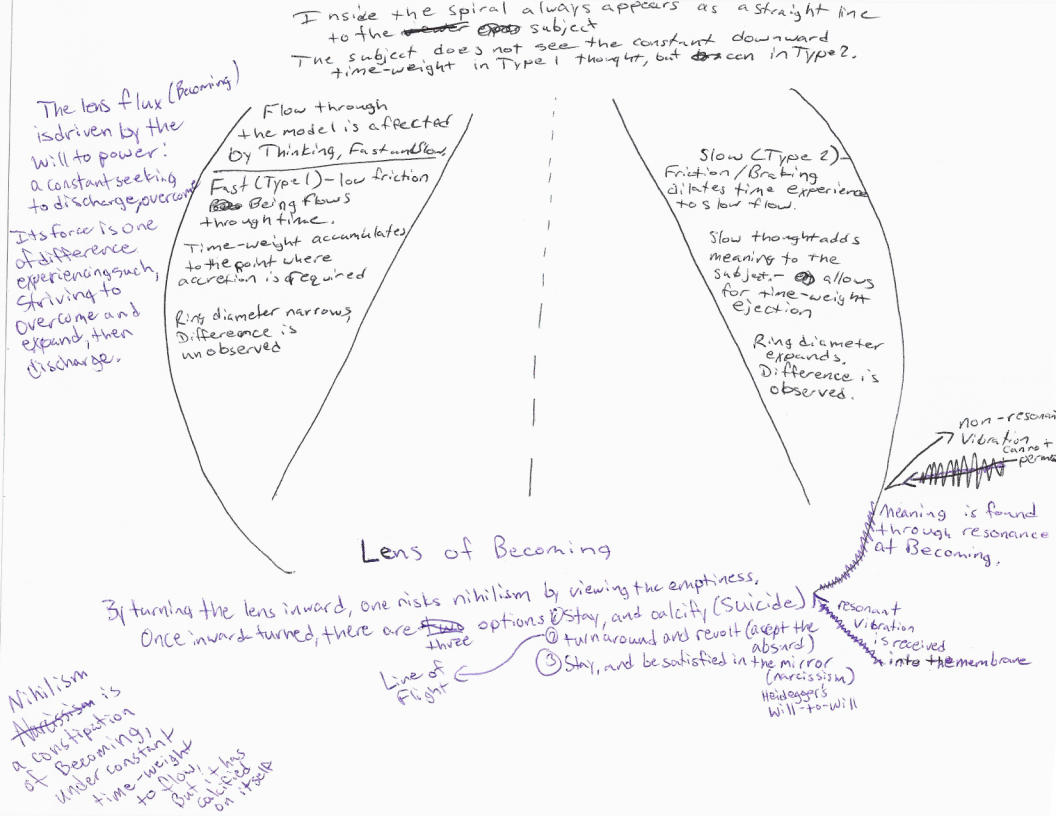
imagine for a moment a single second. within that second, there is a half-second, quarter-second, eighth-second, sixteenth-second, so on and so forth. that single second and be split into infinite slices of time-bits. if those time bits are experienced within the model they take the shape of an infinitely thin lens through which you are experiencing the multitudes of sensational input, thought, emotion, all aspects of becoming at a constant rate of micro-slices. and so becoming, as we said, looks like a straight line simply by extrapolating of those sensations and thoughts ahead of us. the shape is not apparent. the lens of becoming is constantly processing from fluid experience into solid, pushed on by something. that something has entire books written about it, so let's just basically name and describe them.
the initial vector of a birth is the function of thrownness. we're thrown into existence by all forces and existences prior to us and forced to live within the world of all prior history in the motion of becoming. this initial force is then subsumed over time by the individual's will to power. this is the innate internal energy within all livings things to expand, create, and self-overcome. built into the will to power is the force of looking forward with predictive intentionality, or protention.
let the words sit for a moment if you're unfamiliar with how they're used in philosophy. the intent is not to prove them but to display the overall concept by building on prior philosophies.
?
so we can picture the lens of becoming not as a disc, but as a convex circle due to the forces pushing it forward. as time moves, the lenses each solidify at an equal rate of formation of sense experience. since we cannot possibly recall every single slice of experience after they occur, there must be holes throughout the skeleton of having-been, but we also cannot possibly perceive all sensory and thought experience at the rate of becoming, those necessarily must have pores as well. so the experience of becoming and having been is a porous membrane of fluid flow solidifying through time, directed intentionally, whose intentional direction is inherently limited by the time and place and means and capability and experience of difference of the person.
so we're experiencing time like a tube of toothpaste, dry and crusting in the bottom of the tube, always in the opening expecting to be placed where we intend to, or some such metaphor of a metaphor.
now I must borrow again from the sciences: Daniel Kahneman's Thinking; Fast and Slow provided a foundational model for how thought is applied. he gave us the two titular modes: Type 1 (Fast) and Type 2 (Slow). since thought is an integral function of the experience of becoming, they fit almost too nicely within the fluid flow metaphor.
Type 1 thinking is characterized by automatic and repetitive processes. they are attributes that have low friction and allow highly fluid reactions and movements to occur, e.g. flinching, reading emotions, solving basic problems, reading notifications, and so on. these thoughts are constantly running in the background, relying on mental shortcuts and past experiences.
Type 2 thinking is characterized by slow, deliberate, methodical, or new and different thoughts. This mode of thinking requires more metabolic energy to overcome the friction of consciousness.
so the front of the lens is sensory experience (extrapolated by intentionality), the back of the lens is thought process, and how quickly the thought process occurs is directly related to the compression of the lens by both internal and external forces. Type 1 and Type 2 thought can fluctuate in constant and varying oscillation. this image, too, is a posteriori. we can only portray this image of thought after it occurs.
the image of the toothpaste tube once again: squeeze the tube hard, toothpaste moves faster; gently squeeze, toothpaste flows slower. unfortunately, we are not always the only squeezer.
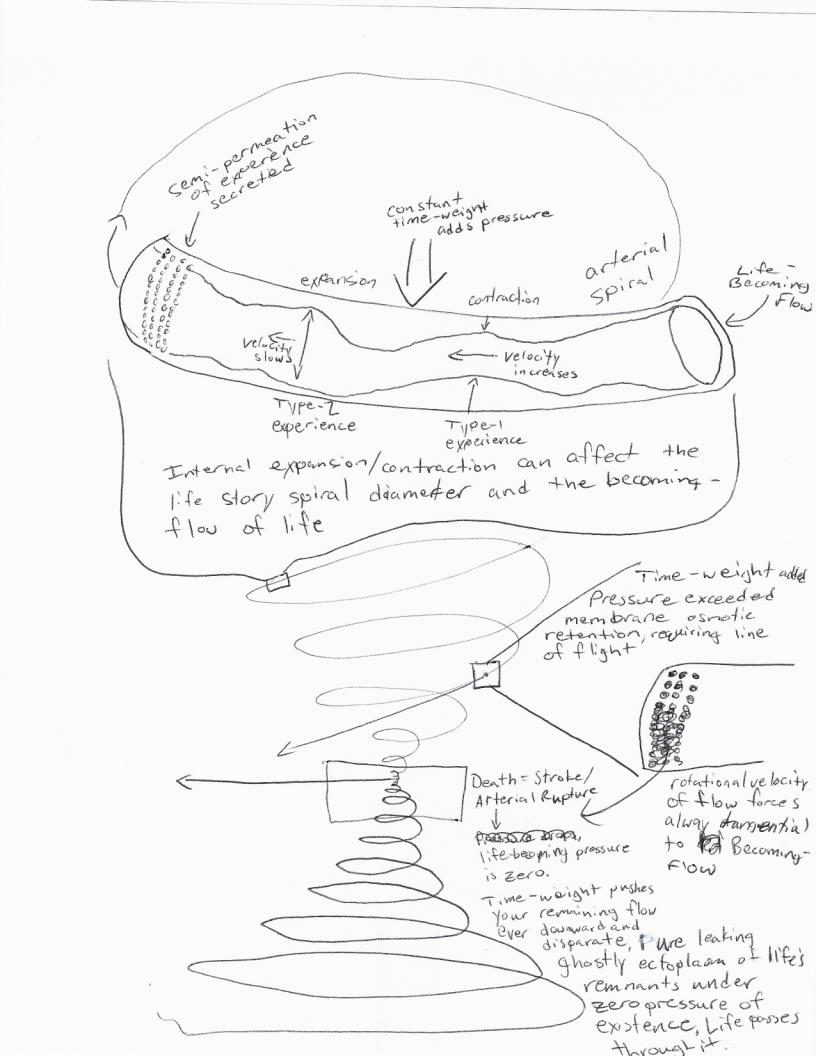
so in this model, the lens is both an image of flow and retention: if your flow through the experience of time were not restrained, the feeling of pressures would not occur. the lens is both a porous membrane which thrownness + will to power + intentionality of experience push through at a pressure dependent upon the forces exerted on the externality through time-weight, angular momentum, and a multitude of forces we will further characterize, and the rate of flow described by externally constrictive (Type 1) and externally dilatory (Type 2) thought, which is calcifying into having-been after the experience occurs.